How many of you out there love “Sex and the City”?Well, it’s my favorite show of all time. The other day I saw the episode (again) where Carrie helps get a stuck diaphragm literally “out of” Samantha. Carrie takes a stiff drink and “goes in” to help…
I am proud to say that I have friends who would do that for me.
I am even prouder to say I have never required them to do so.
Forever friends are never obsolete
Lifetime friends. I have many…not a singular core group like in Sex and the City, but unbelievably good friends who I have discovered at different times and in a variety of interest areas of my life.
Some are from my childhood, others are from my wilder college and young single’s days, still others I met early on in my soccer mom transformation; becoming friends while hauling strangers’ kids to yet another field trip and meeting up at fundraising events.
They are actually an incredibly varied group from all walks of life. I trust them. I love them. I laugh with them (and sometimes, at them, as only a great friend can). And there is a huge comfort in knowing they are out there, at the other end of a text message, always willing to be supportive or make just the right joke for a particular crisis or situation.
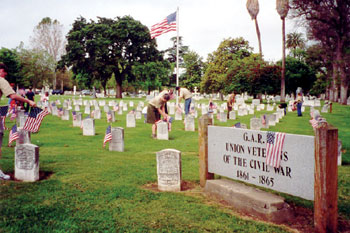
Not everyday, just on one weekend a year, Memorial Day weekend. On that weekend, I go to the cemetery, visiting the graves of dead soldiers. I go with the local Boy Scout troop.
At the cemetery, the scouts plant American flags at each soldiers’ grave. One weekend of tribute to those who have given so much.
The scene is haunting. Row after row of flags…so many flags…dead soldiers from Vietnam, from WWII, even from the Civil War…and more recently, from Afghanistan and Iraq. Hundreds and hundreds of flags. It would almost be beautiful – all of those flags, gently waving in the breeze – stretching out as far as one can see – except for what the flags represent. And in that breeze, in the cemetery, that’s when I hear the voices.
The voices tell of lives that ended too abruptly. Parents taken away from their children, families shattered. You can hear the pain above the quiet flapping of the flags. And you can hear the pain in the quiet movements of visiting family members, their faces still twisted in sadness regardless of how long ago their soldier died.
The younger scouts run excitedly to hammer in yet another flag. They understand the flags are all about honor, but they are too young to hear the voices, to really understand the pain, the sacrifice involved resulting in all of those graves. When we finish, and look out at the sea of flags before us…that’s when it really hits you, the enormous cost of war…or of peace, depending on your point of view.
Once, when we were finishing up placing the flags, an older woman walked up to me with tears in her eyes. She put her hand on mine and thanked us for honoring the dead soldiers. I assumed her husband, brother or son was among the graves; I thought about that young man, how he must have felt so many miles away from the family he loved. How he must have felt, in a terrible place, doing terrible things. I thought, too, about the woman. She might have been much younger then…full of expectations and dreams. I wondered what she might have been doing, that day she found out that her soldier had been killed.
And what about today?
Parents of soldiers stationed overseas wonder if their child will be the “one soldier” killed in the latest news report.
Today’s troops are the living soldiers. Today, they are the ones in terrible places doing terrible things. They are risking their lives, missing the births of their babies, and putting their futures on hold…sometimes indefinitely.
I wonder how today’s soldiers feel on Memorial Day. I wonder what voices the living soldiers hear on a day when the dead speak so loud.
If you’ve ever gone to the cemetery on Memorial Day weekend, and heard the pain, you would want today’s soldiers to instead hear the voices of your support. You’d want to raise up your voice…not to chant against or for war…but to show our troops that you care about them. Those are the voices I want to hear this year, a unified American voice of support for our troops.
Send a letter of support to a soldier or a soldier’s family (Forgotten Soldiers is one site that can get your letter to a soldier). Hang a yellow ribbon or the US flag. Remember the emotional response we all had after 911…let’s see some of that flowing to our military. Give blood. Pray. Attend a Memorial Day tribute. Thank a soldier or their family. And yes, it is ok to want peace…or question a politician’s decision…just don’t forget that our military are over in terrible places, having to do terrible things, because it is their duty…and perhaps not even their choice.
As Memorial Day weekend comes to a close each year, the scouts return to the cemetery and quietly pull up the flags, folding them away carefully for the following year.
More flags will have to be bought. They always need more each year. More graves….more voices in pain…
As we leave, and look out at the stretch of green – now absent of the patriotic tribute – the cemetery seems quite empty. Only the pain lingers on. I guess I will hear the voices again next year.
Editor’s note: This was written many years ago and featured in a few local newspapers, when my sons were still in scouting… I’ve updated it and hope you will consider reaching out to a soldier or attending a Memorial Day event… it means a lot.
Most of my friends and readers know that I’m adopted.
Some have taken the time to read my various blogs about finding my biological mom (NOT a good ending, unfortunately) and finding my biological dad (well, at least he didn’t send his lawyer after me!). If you’ve stuck with me through these very personal stories, I thank you!
And if you read a copy of my recently published book, Caring for Mom and Other Loved Souls, I also thank you! And if you actually took the time to leave a review for the book, I applaud you for supporting a first-time book author. I know it might not be easy reading a memoir about a 93-year old’s end of life… especially someone you likely didn’t know. But it was a story I had to tell, about my “mom” (my adoptive mom who raised me and who I view as my true parent). And I’m more than thrilled that it is done and out there.
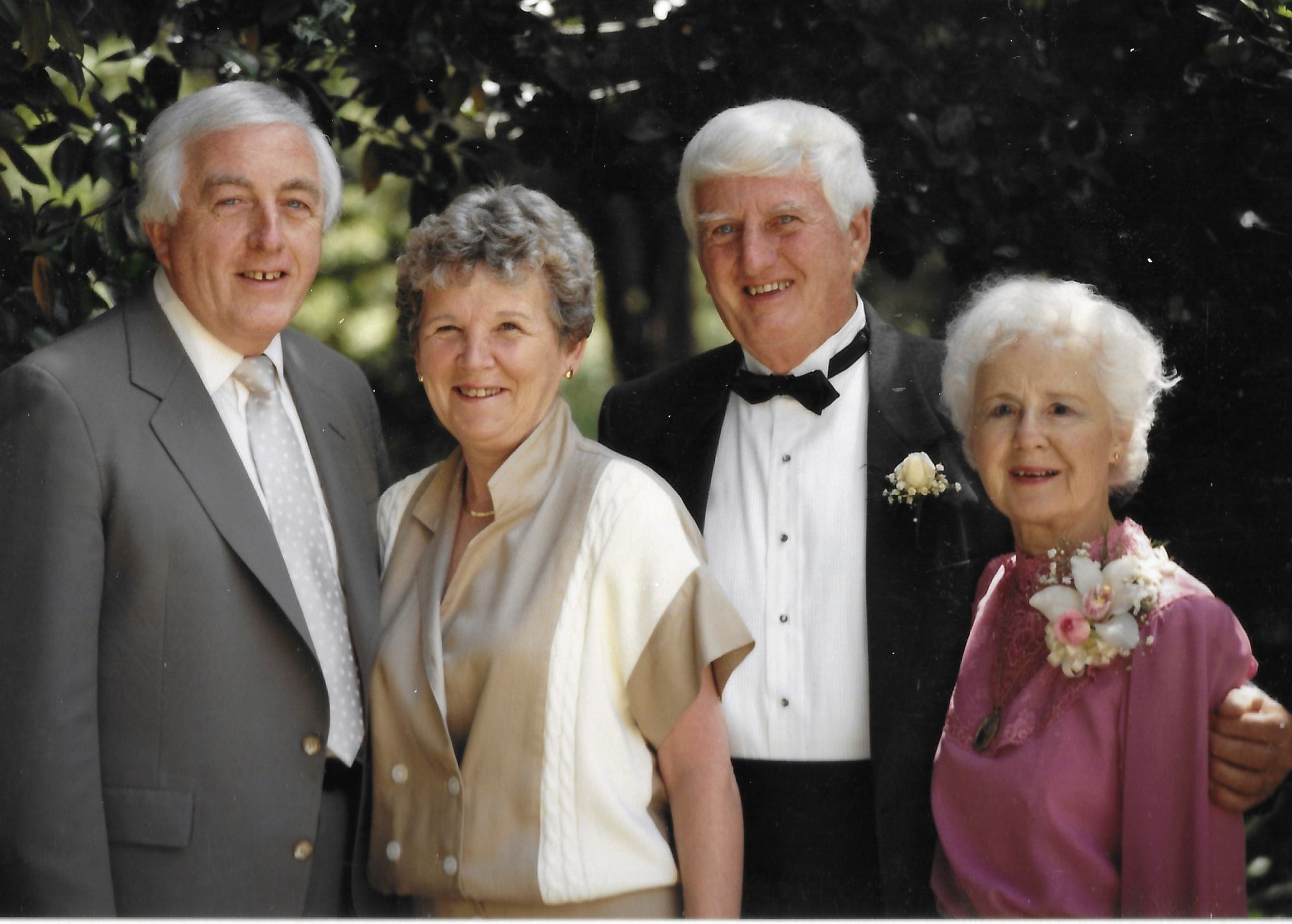
This past month my Uncle Joe passed away at the amazing age of 95. My father’s brother (again, I know it’s confusing, but I’m talking about my adoptive father, Ed, who raised me, and who I view as my real father). Here’s a photo of my Uncle Joe (from left to right), Aunt Helen and my parents, from my wedding in 1987.
My Uncle Joe’s death brought up a lot of memories about my father. Joe was my dad’s younger brother although Joe outlived my dad by 33 years. My dad passed away at the age of 68, decades ago. He was robbed of so many good years. My two sons never knew him, an enduring sadness for me.
Two wonderful people chose me to be part of their family. I had a beautiful life with loving parents, and I couldn’t have had better role models, felt more loved, or loved anyone as much as I loved them. I always viewed them as my “true” parents. When I was very young, and they had told me I had been adopted, they said they had chosen me, out of all the other babies, at the baby store. I felt so special then, and still do today.
They both are gone now and I miss them dearly.
I had never given much thought to who my biological parents were. I always felt it didn’t matter, that their pairing—and my conception—was only a biological accident involving sperm and an unprotected egg.
But then, about 6 years ago I wanted to find some information on my family heritage. This was driven more by my young adult sons, frankly. I wanted them to have some info on their ancestry, as well as to not have to wonder about what health-related concerns they may have inherited from unknown genetics. All my life I had always had to draw a huge X across the “family medical history” sections when filling out the paperwork at doctors’ offices.
Along with routinely sharing a great deal of storytelling throughout my youth, my parents left me with many family photo albums and boxes of both our family and distant family memories (including letters, scrapbooks, military artifacts, and more). My mom even wrote a short autobiography in her later years, which is packed with her lifelong stories, and is such a treasure for me.
Throughout my life I have always been one to collect and preserve memories. Some people might even say I’m a “memory hoarder” and they would probably be right.
Ah, memories, and the stories behind them. They were important to my mom and they are important to me.
I wrote this several decades ago, but no matter how much time passes, it is still so true!
As Mother’s Day approaches, I was thinking about something that my young son said to me several years ago. We had been talking about college, and what it means to get a degree. I had told him about my own college experiences, including graduate work. He had listened intently, and then asked in an almost accusatory tone, “You went to that much school and only became a mom?”
I had laughed then. And now, years later, it still makes me smile. That sentence is right up there near the top of the list of priceless things my kids have said to me. On that special list, it’s right under the question, “Did you vote for George Washington?” and is also near the sweet proclamation once uttered by my younger son, “Mom, I’ll love you even when you’re dead and I have a new Mom.”
Ah, yes… being a mom. It is definitely something unique and wonderful.
I haven’t written much for my blog over the past few years. I guess I’ve been busy.
I did write a book and have continued with my freelance writing. But I’m a passionate journalist—who loves writing about my own observations in life—so it seems strange I haven’t been more focused on this blog.
Ahhhh….maybe THAT is why I have shied away from writing more?
Nah….
Actually, the major distraction in my life over the past few years was selling our family home of some 30 years… downsizing all our belongings… and then moving.
My “kids” often say I’m a technology dinosaur. But I’m a dinosaur in so many other ways as well.
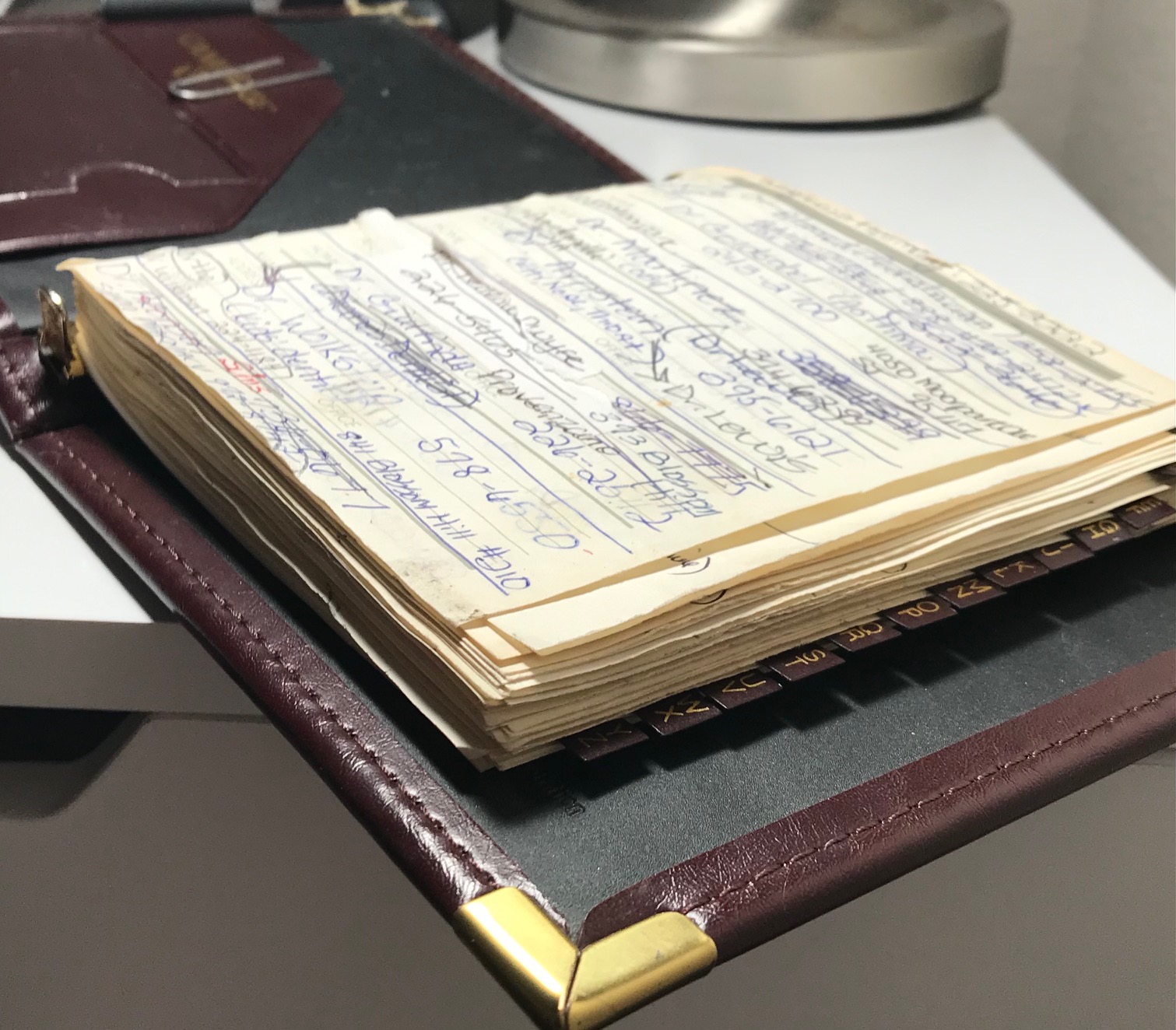
Recently, when I reached for my spiral-bound, paper-based address book, I caught myself reflecting on the many cross-outs throughout the book—as well as the many entries needing to be crossed out!
Now keep in mind, my address book is at least 31 years old. How do I know that? Well, it contains my 31-year-old son’s original pediatrician’s phone number (the one who actually came and examined him at the hospital when he was born). A month later we ended up with a different pediatrician, so the original doctor’s name and info was soon crossed out. There’s still an arrow from that cross-out to the replacement pediatrician’s name and number. Of course, that doctor’s contact information, too, was crossed out long ago.
But now…. finally… my passion project has been delivered! I’m sure my parents are up in heaven, smiling with pride!
Would love to hear your feedback!
Book description:
Most people will be a caregiver or care receiver in their lifetime. What will that experience look like for you?
Caring For Mom and Other Loved Souls tells of one daughter’s journey as a caregiver for her elderly mother, recounting both the “blessings” and the “stressings” that she, her husband, and two young sons encountered while caregiving in their home. Along with the author’s personal story, she has woven in over a dozen other caregivers’ insights, including those having lost their loved ones to Alzheimer’s disease.
It highlights the challenges—and many benefits—of multigenerational living (aka “sandwiched caregiving”), and discusses the importance of managing both caregiver stress and the seemingly endless feelings of caregiver guilt. The author does not shy away from the mistakes she made during her own caregiving journey—nor her need for help and support to cope with the loss of her mom as well as the loss of her longtime caregiving role.
While the book may leave a reader teary-eyed by its raw emotion (often presented via the actual journal entries and emails written at the time), it also shares the humor and lighthearted stories more typically found behind the public curtain of caregiving.
If you have been or currently are a caregiver you will likely relate to the author’s and “other loved souls’” journeys—and the book’s honest and heartfelt narrative should prompt you to laugh, cry, and reflect on your own precious caregiving moments.
And while everyone’s experiences will be different, the author found many common threads during her interviews with other caregivers. Those are represented and shared as caregiving “truths” and philosophies that will help guide anyone becoming a caregiver in the future. A few examples are: knowing and accepting that every caregiver will be faced with “unable to do” moments and the need to plan for those. Also, as a caregiver, adjusting your perspective to match the care receiver’s. So often as caregivers, people react to everyday situations based on their wants and needs, versus those of the person they are caring for.
Caring For Mom and Other Loved Souls is not a handbook for daily caregiving tasks. Instead, it provides the reader with helpful and inspirational guidance—and practical advice—centered on the mental and emotional struggles of caring for a loved one, losing them, and surviving their loss. It also underscores the importance of family and shines a light on what caregivers are truly capable of doing in the name of love.
Please help out a first-time author!
Order my book and if you feel so inclined, please leave a nice comment…would very much appreciate it.
It’s Not Just About Saving the Ta-Tas, It’s About Saving Lives
Well, it’s been over a month since I walked in the 60-mile Avon 3-Day Breast Cancer Walk. 12 blisters are finally healing, I’m not limping anymore, and I’ve finally withdrawn from Gatorade. So, I am sitting down and writing a re-cap of a truly unbelievable, inspiring experience.
Day 1: Excitement…and great surprise!
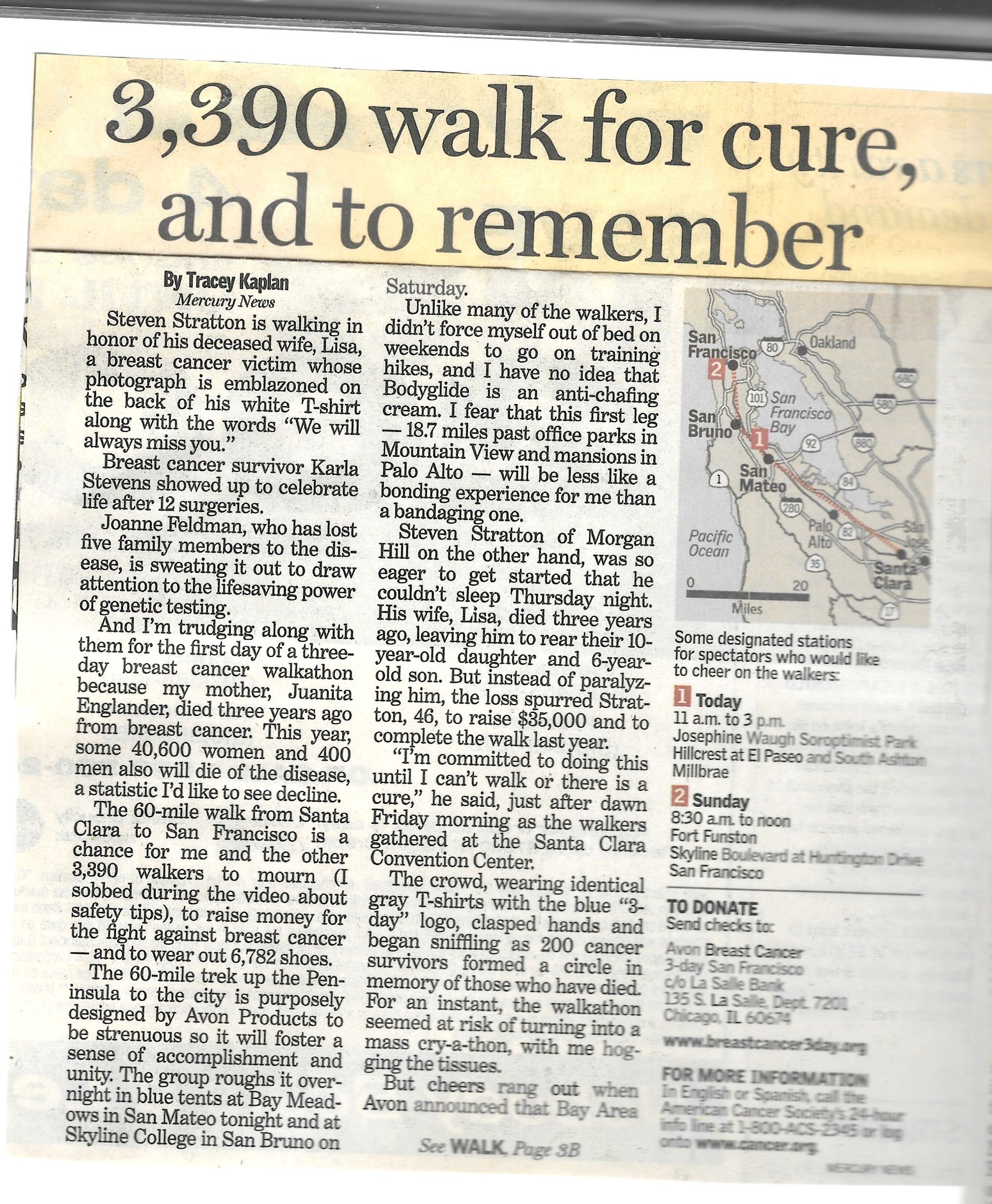
The 3 days began with over 3,000 fresh and eager walkers starting out the gate, as escorts of San Jose bike and motorcycle cops lined the route. Quite the media event, with helicopters filming and thousands of supporters clapping, waving and wishing us well.
I was tired and distracted, but glad for the 3-Day to finally be here after some 4 months of training. My mom had been taken by ambulance and hospitalized the week before, and was still ill, and it was somewhat questionable right up until the night before the walk as to whether I’d be able to even do it. The stress of her illness, and staying up late the night before to pack at the last minute, had made for a somewhat less than perfect send-off that morning. I was feeling pretty miserable, not at all how I had hoped to feel on the initial day of my trek. But soon, the energy and enthusiasm of the crowd gave me the shot of adrenaline I needed to get moving.
The mood for Day 1 could best be described by two words: excitement and surprise. The surprise was how emotionally impacted I would become during the walk, especially on that initial day. I would never have believed how touched I would be by the extensive support we received from strangers along the route. People you had never met before—and would probably never meet again—were supporting you with such emotion and care. It wasn’t just a cheering section like at a competition (urging you on to the finish line); instead, it was very intimate, with people sharing their emotions and own personal wounds openly with thousands of walkers.
Supporters cheered and cried. People high-fived you with such enthusiasm you would have thought they were your best friends. People positioned themselves along the route in lawn chairs offering a squirt of a hose to hot, thirsty walkers. There were children holding up pictures of their female relatives (moms, grandmas, aunts and cousins) impacted by breast cancer, along with a sign saying “thank you for walking.” I came across an older woman crouching by a large framed photo of a young woman. I guessed that it was her daughter. Words written on the front of the photo simply said, “thank you.” An older couple silently sat along the route, nodding to walkers—with tears in their eyes—as the stream of walkers went by.
A group of strangers spontaneously hugged a breast cancer survivor walker as she walked by; survivors could be identified by special pink hats worn during the walk. A man blasted “Pretty Woman” on his truck stereo as walkers passed by. This same guy, who we nicknamed “the Pretty Woman Guy” showed up no less than 20 times throughout the walk; he turned out to be the husband of a walker. A woman in a wheelchair clasped my hands and gave me an endearing squeeze while choking out the words “thank you so much.”
And if the supporters didn’t leave you in a state of awe, getting to know your fellow walkers did. Along the route I read the backs of hundreds of t-shirts, most were memorials to someone who had either survived—or died of—breast cancer. There was a man with a picture of his wife and kids on his shirt, walking in her memory. She had died of breast cancer 3 years before. Hearing him talk about his wife’s ordeal and how his kids had handled everything, and hearing his pain, was very inspiring. He had made a commitment to walk every year until there was a cure. I’m fairly certain he is still doing the walks (or some form of fundraising), and likely his whole family is out there as well.
There were hundreds of other stories that went with hundreds of other t-shirts. It seemed like the walk was a cathartic event for many people, sharing their pain and as well as fond memories. I was brought to tears by some; giggled at the stories of others.
At the time, I didn’t have a personal “story” relating to a family member or friend dealing with breast cancer. I was walking so that I would never have a story. I was walking so that my 3 nieces, other family, and my friends, would never have a breast cancer story of their own to share.
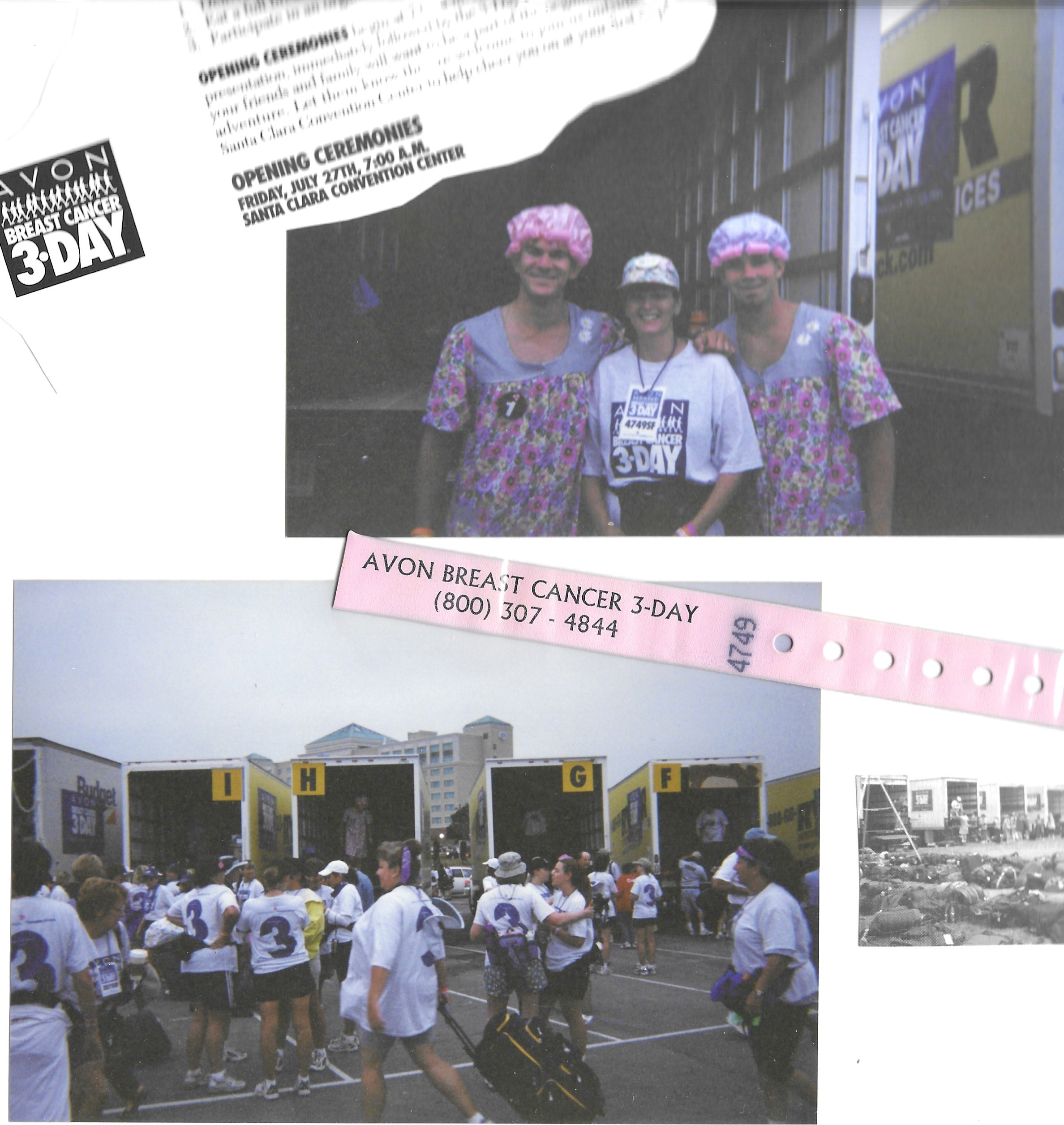
The 3-Day was well organized and they did just about everything they could to support the walkers. The walkers’ gear (tents, sleeping bags, clothes and toiletries) was taken to each camp via trucks so we only had to carry whatever supplies we wanted to haul around. I had ample moleskin/band-aids and electrolyte packets, along with layers of clothes, and my phone. I had bought a special fanny-pack that allowed me to carry two bottles of water at all times. One of the biggest priorities for all the walkers was to stay hydrated!
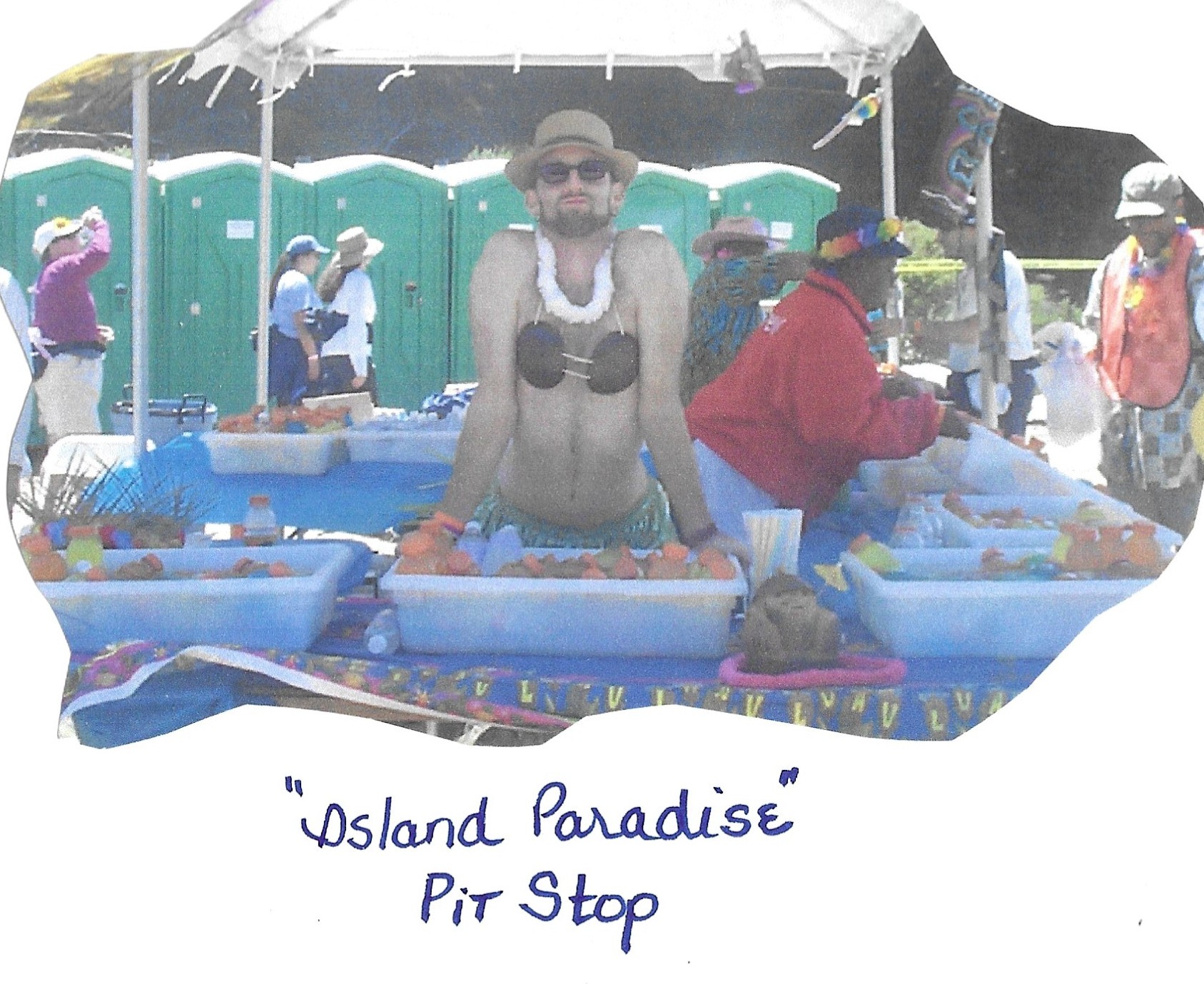
There were numerous pit stops along the routes, most having a funny theme, like “Island Paradise,” with themed decorations and volunteers wearing some pretty hilarious costumes. You could always get water and fruit, some salty treats, band-aids and various medical supplies, and of course, there were lots of porta-potties. They also handed out pit stop specific souvenir stickers to stick on the 3-Day ID card that hung around every walker’s neck. The volunteers were relentless about hydration and self-care. I must have heard, “are you drinking and peeing at every stop” a million times!
At one of the first pit stops, I talked with a breast cancer survivor about the many treatments she had had. She didn’t expect to finish the walk, but had wanted to participate as much as she could. She was wearing a t-shirt with many names of the people—including several family members—she had lost to breast cancer. When I left the pit stop, she was still sitting in the medical tent area, and looked very tired. I don’t know if she continued on or not. Many walkers didn’t complete that first day without some help along the way. Some were transported to later pit stops. Some ended their day early and were transported to camp. Although most walkers wanted to walk every mile on their own, the walk wasn’t really about the mileage. It was about showing up, raising funds and awareness, and doing the best you could.
I expected to finish the walk. I knew I’d suffer with blisters, as I had been plagued by them during training, but I fully expected to make it through the entire 60 miles with a minimum of pain.
Boy, was I in for a surprise!
With a prick of a pin, I had my first 3 blisters lanced that first afternoon. I then must have changed my gait or something (to reduce the pressure on my blisters), because my knee started to really ache later in the day, something that hadn’t happened during my training walks. I still was able to keep up a pretty good pace, however, and was in the initial third of walkers when I walked into camp that afternoon. I didn’t realize it at the time, but moving so quickly that first day was going to catch up with me sooner than later.
Night 1: A Mobile City
The first night of camp was at Bay Meadows (yes, the horse racing track). I had just walked through the applause of camp volunteers who were waiting at the Day 1 finish line, and was feeling pretty good (although more than ready to get off my knee). The “finish line” for Day 1 was not such a big deal. The real power of Day 1 was in the inspirational route, not the finish.
Once through the finish line, we were immediately sent to get our gear and tents off of the gear trucks. While the trucks hauled our stuff from camp to camp there was no one to carry your stuff from the trucks to the camp itself. No matter how much you ached or were tired, you needed to tend to your own baggage. Once we had our 30 pounds of gear, we schlepped that—what seemed like miles—to assigned tent sites. We had to set-up our own tents and tote our gear back and forth to trucks every am and pm. The camp joke that night was whether you thought the actual walk or the camp check-in and set-up was more grueling that day. Once everything was set-up at my tent-site, I struck out on another long walk to get to the showers.
In our mobile city, huge trucks housed the portable showers. If you had told me I’d enjoy showering in a truck with dozens of strangers I would have laughed, but it was GREAT! The water was hot and felt soooooo incredibly good at that point. Then it was off to the medical tent to tend to blisters and ice my knee. Talk about the walking wounded. Lots of ugly, severely blistered feet out there. Lots of bandaged legs, shins, and knees. Hundreds of people icing some part of their body. A few people even on crutches. And sadly, I saw more than one walker taken by ambulance to the hospital due to severe dehydration; scary given that most of these people, like me, had been training for months. There were physical therapists, chiropractors and massage therapists. People were lined up in a triage type of arrangement…the worst cases got the most attention…a lot of problems were simply dealt with using lots of ice. The whole thing reminded me of a scene out of M.A.S.H. (but without all the blood).
Much like the shower, dinner was sheer ecstasy. Was it really that good or was I just incredibly hungry? I went to bed early but between porta-potty doors slamming, sleeping on the ground, and late-night conversations from thousands of tents, I didn’t sleep well. I was worried about how my knee was feeling, and thinking about the challenges to come the following day. I got up once during the night to pee, and with flashlight in hand found my way to the porta-potties. Let me just say that there is nothing quite like stepping out of that dark porta-potty and looking out at thousands of identical blue tents and realizing you aren’t sure which aisle you need to turn down to get back to your tent.
Day 2: Pain…and a surprise visit from home
While Day 1 was flat, long and hot, Day 2 was supposed to be shorter (just 16.5 miles), but hilly, hilly, and hilly. Nothing prepared me for Day 2 given the pain in my knee. It hurt almost immediately that morning. I can honestly say it was pretty much painful—to varying degrees—the entire rest of the walk. The hills were the real killer…not the uphill, but the downhill…very painful on my knee.
There was definitely a change in mood the second day. Less chatting, less high-fiving. People seemed a bit tired and many (most?) were already suffering from some kind of injury or blisters. I had started the morning walking with my tent-mate, Eileen, who was suffering from some leg pain of her own, but once we got split-up I ended up walking among several “teams” along the way. These were a lot of groups of walkers walking together, most were wearing some kind of matching attire (e.g., propeller-heads, flamingo hats, matching t-shirts, etc.). I talked a bit to passing walkers, eavesdropped on some of the teams’ conversations and home-grown songs, and tried to focus on the beauty of the neighborhoods we were in. Taking a lot of Tylenol and using pain patches on my knee helped, but I was already wondering if I was going to make it to the end of the walk. At times, I was seriously wondering if I’d even make it to the end of the 2nd day!
At lunchtime, John (my hubby) and Christopher (my 9-year-old son) surprised me with a visit. Amazingly, they somehow found me among the thousands of walkers at the rest stop. Somewhat embarrassingly, I was lined up at the medical tent to have my blisters dealt with. After a nice visit (consisting of some much-needed pumping up from my family), and re-popping and bandaging what were now about 6 blisters, I headed off to finish the remaining 4 ½ miles for the day. Next up was a hilly stretch the 3-Day Walk people referred to as “Hope Hill” (but was known affectionately by walkers as “Hell Hill”). It was very hot and sunny, so people were dreading this leg of the walk.
Luckily for me I had done a ton of steep hill training. The uphill climb was easy. It was incredibly easy, actually. I was quite surprised. I had been so afraid of this hill based on the folklore I had heard. I easily finished it. It gave me a morale boost in several ways: one, that I had made it so easily (many weren’t doing so well), and secondly, the support along the hill route was awesome. Spectators and hill residents were out handing out Popsicles, sprinkling people with hoses and water guns. Some kids had set up a free lemonade stand. Signs were posted everywhere, thanking walkers. Cars and sweep vehicles (trucks that made regular passes of the route that could pick up any walker who needed help to the next stop) honked and looked for “thumbs up” signs from struggling walkers. I was literally feeling “at the top of the world” when I reached the top and looked back to see a long stream of walkers, many who I had passed.
That feeling was short-lived however, as now I was faced with the downhill side of Hope Hill. As the route started a long, downhill trend, the pain in my knee got much worse. I had to literally limp much of the way, and stopped often to stretch. Fellow walkers kept asking me if I was all right, and gave me words of encouragement. Many people passed me over those last few miles. It was depressing, and I kept thinking about how I was just not going to be able to finish the third day. I didn’t talk to very many people at this point. I was focused on just finishing. I managed to keep up a slow, but steady, pace throughout the rest of the day. Luckily, it was a short way to camp.
Even in my somewhat unhappy state, I was still impressed and moved by the incredible show of support. There were lots of “recurring” characters that the walkers had named: the “Pretty Woman Guy”, the “Guy With The Dalmatian”, the “No-Hands Guy”, the motorcycle club that kept roaring by and honking…and lots of new characters all along the route. The San Jose bicycle police were also just awesome, keeping us safe as well as continually providing us heart-felt cheers and atta-boys.
Night 2: Ben-Gay and Ice
When I finally did finish the Day 2 route and arrive at Skyline College, my tent mate’s husband and kids had already set-up our tent. All right team Mitchell! Because I was much later coming in to camp on day 2 than the first day, I found that there were lines for everything, for showers, the medical tent and for food. I was a bit down, so it was nice to see John and Christopher show up again (and bring me some much-appreciated Ben-Gay for my knee). Ice and Ben-Gay! Ahhhhhhhhhhhhhh! Christopher was impressed with both the number of porta-potties and tents, and wanted to stay and cuddle with mom. I was sad when they left, but rejuvenated by their support.
It was getting cold and windy. Skyline can be brutal in terms of wind and fog and we had been prepared for the worst (it had actually rained the previous year). Luckily, the fog didn’t roll in so we didn’t have the dampness experienced by the previous year’s walkers, just cold and the whipping wind. I actually slept well, most likely from sheer exhaustion.
Day 3: Beauty everywhere… but more downhill!
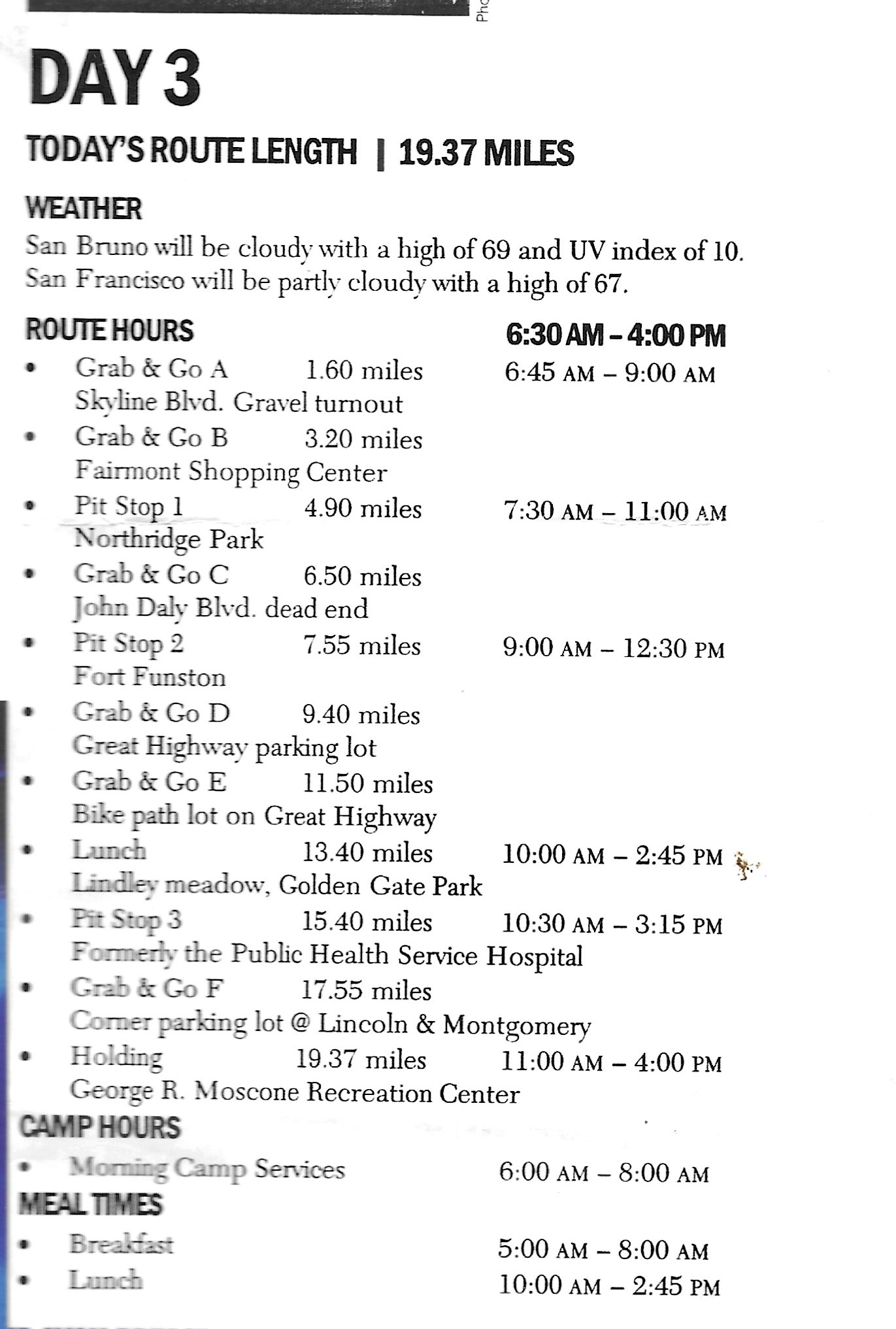
At 5:00 am we packed up quietly in the dark, turned in our tent and headed out onto the flare-lit road. The really bad news—at least for me and my sore knee—was that much of this morning would again be downhill. My knee hurt at every step. My strategy for day 3 quickly became “just make it to the next stop”. Stops were about 1 ½-3 miles apart. I walked very slow and limped on every downhill stretch. Even stepping off of curbs at each street corner was now quite painful.
But just when I would have mentally decided to stop, something along the route would inspire me to continue. The many supporters with their sincere and emotional words of thanks. The bicycle cops who formed a tunnel with their bikes and high-fived walkers as they finished a hill. Seeing fellow walkers being patched up at pit stops, seeing the determination to finish. There was a quadriplegic woman doing the walk, and seeing her along the route was very inspiring. It definitely wasn’t a matter of inner strength at this point (I had pretty much exhausted that), it was all of the emotional injections provided along the route that kept me walking.
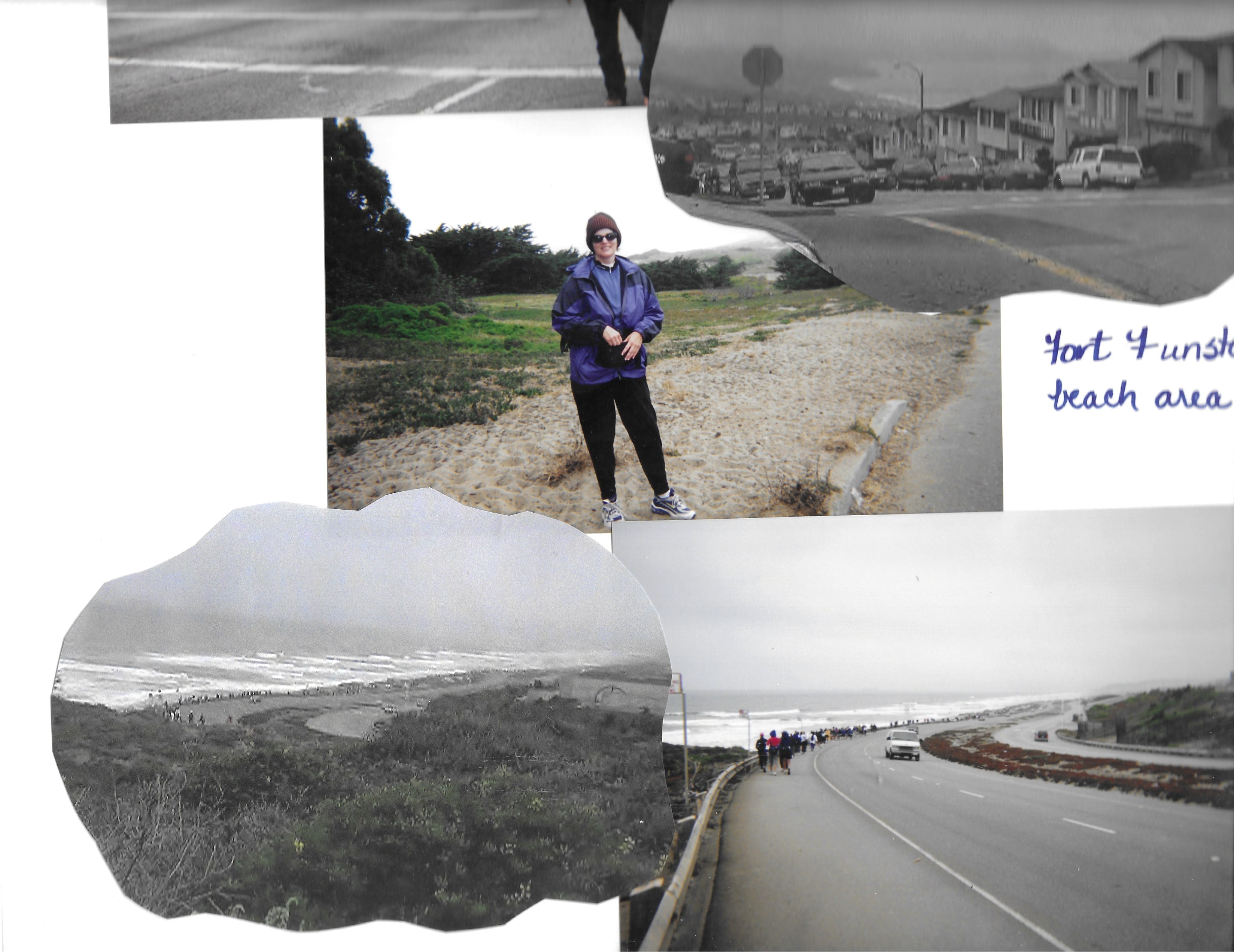
The scenery also helped me focus on something other than the walk and my knee. We went into a forest of sorts, walked by a lake and then actually walked out onto a beach. It was really a beautiful walk if it weren’t for my pain. I didn’t realize it at the time, but most of that morning I walked alone and didn’t talk with anyone. About the only interaction I had with my fellow walkers at this point (other than the constant stream of people telling me they were, “passing me to the right or left”) was when groups would ask me to take their picture along the way. I finally asked someone to take my picture. It shows me heading towards the beach, still wearing my knit cap and windbreaker from the cold morning. I’m not sure the picture captured how I felt at that moment. I am smiling in the photo but I felt weary and alone. To be honest, I think I may have even cried a bit a few times that day. Even with pain patches and Tylenol my knee was killing me, and more than a dozen times people stopped and asked me if I was ok.
When we got to the beach I did finally pair up with a nice lady who was a breast cancer survivor. She was surprised along the route by family and friends, and was very touched by their support. I hooked up with her as she left her friends and re-joined the route. We had a great chat about our families and lives. As we walked, we came across the beachfront apartment that I had lived in some 20 years before while in college…it was surreal…. It really helped to focus on something other than the walk, because before I knew it, we had gone another several miles. We got split up at a pit stop, but I wish I could have thanked her for helping me get through a difficult time during the walk.
Somehow, I made it to lunch; fairly late, but still among throngs of walkers. It was a party-like atmosphere, with early walkers still hanging out with family and supporters. I personally didn’t appreciate the crowds or jovial atmosphere at that point. I was in a robot-like mode: eat, get blisters popped and attended to, put Ben-Gay on knee, pee and decide whether to continue on.
While I waited in the long lunch line, I heard an announcement over the loud-speaker. Walkers had to make it to the end of the route before 4 o’clock, or you’d be picked up (“swept”) to the finish. This would mean a brisk pace—especially given my knee—if I wanted to finish on my own.
As I got my blisters attended to (I now had some really bad ones that oozed blood), I thought about what I been through already. With only a handful of miles to go I decided that there was no way I wasn’t going to do this.
Once that decision was made, I was somehow was able to re-energize myself. I literally pushed my way through the next pit stop without even stopping. Amazingly, I somehow kept up a brisk pace all the way to the end. I was now the one saying “passing on your left” to the hundreds of walkers making up the last third of the pack. I will shamefully admit that it felt good to be the one pushing through.
As we walked the last few miles, the crowds increased along the route. People were everywhere, and all of them were shouting the remaining mileage…we were almost finished. I finally allowed myself to feel good about the fact that I was going to make it, and complete the entire walk. I started to enjoy the increasingly jovial atmosphere of the walkers and crowds.
The end is near
At the end of the walk, we were directed to a holding area. We’d all walk to the finish line together from there. As we entered the holding area we came to a solid tunnel of people. Hundreds of walkers (who had already come in – many much earlier in the day!), volunteers and supporters were lined up to welcome in walkers. This tunnel just kept going and going, what seemed like for miles at the time. I must have high-fived no fewer than 50 people on the way in. People clapped, yelled and hugged. After minutes of walking thru the endless line of supporters, I found myself actually trembling and in tears. It was overwhelming.
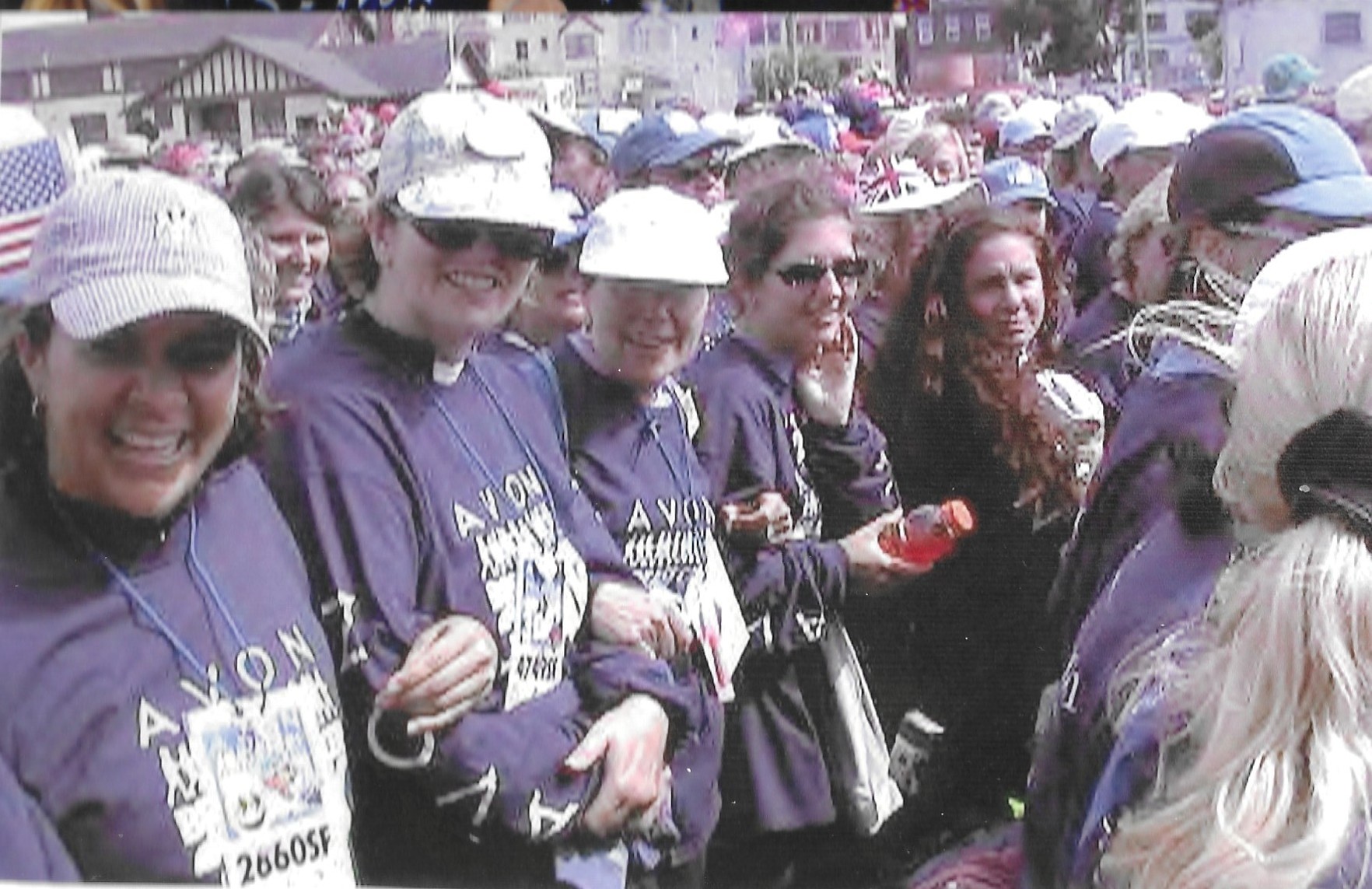
A daughter and mom who had walked together hugged. A survivor who had walked pounded a fist upwards at the sky, as if to say, “not yet!” I ran into my tent-mate in line and she gave me an excited, congratulations hug (and took my picture as I came through the tunnel of supporters, shown above). I had beaten the deadline by less than 45 minutes, but I had made it the entire way.
We were now in a holding area awaiting our grand entrance into the Marina, where the Closing Ceremony would occur. Everyone changed into matching 3-Day shirts and excitedly awaited the final .2 mile into the Marina. While waiting, a roar of applause broke out up at the front of the tunnel of supporters, who were still welcoming in the final walkers. I was at the end of the tunnel, and couldn’t see what the mania was about…a few minutes of applause and yelling took place before I could see what was happening. The San Jose bicycle police, who had escorted us the entire way, had ridden up through the tunnel, and people were showing them their gratitude and support. They had been so great, not only keeping us safe, but in keeping us going with their cheers and humor. They were the last folks through the tunnel. People then started to line up for the closing ceremonies. Arm and arm, we walked slowly down to the Marina, chanting some home grown 3-Day theme songs as we went.
The closing ceremonies were not as emotional for me as the holding area tunnel or the walk itself, but people who attended it said that the sheer number of walkers marching down the road was an incredible sight to see. When Christopher finally found me in the crowd, there was pride and delight in his eyes. Although I know he didn’t quite grasp the entire 3-Day purpose, he had seen—and experienced—the sacrifices made by our family over the 4 months prior to the walk. The training had greatly impacted my ability to be with and tend to my family’s usual needs. Training, along with my mom’s poor health, had created a lot of stress in the home. I don’t think my kids really knew why I was spending so much time out walking (probably 5 hours a day!). But after seeing all of the walkers, I think Christopher knew that his mom had participated in something very big and important.
On the way home, I talked a lot about the walkers’ stories. I spoke of the many supporters along the route who had lost loved ones to breast cancer, and how touching the whole thing had been. Christopher held my hand continuously for the hour-long drive. Unlike many of the moms, wives and friends of my fellow walkers, his mommy was coming home.
Final facts from the 2001 3-Day Walk
A woman’s chance of having breast cancer during her lifetime is one in eight.
Your chance of knowing this woman is nearly 100%.
The 2001 San Francisco 3-Day Walk brought in about $5.5 million (net) in funds to fight breast cancer (this is the amount that goes DIRECTLY to fight the disease)
I topped my own personal fundraising goal of $4,000 and raised just over $7,000 in funds (this includes corporate matching dollars and direct donations)
In polling other walkers who wore pedometers during the 3-Day, the final mileage was over 65 miles, and more than 150,000 steps.
Life after the walk
The 3-Day was definitely something I’ll always remember.
At the time, people kept asking me how it was. It was hard to describe it in simple words. It was many things: fantastic, awful, inspiring, painful, a blessing, a nightmare, cheerful, lonely, beautiful, overwhelming, and at times, surreal.
It was all of these things, packaged up in a journey that we seldom take the time to make. The journey was not the stuff of our daily lives. It was taking time off from the usual to challenge yourself and to make a difference. Just being able to do the walk made you realize how much of a gift it is to be alive and healthy. One of my fellow walkers had a saying, and I think it sums up how I felt after completing the walk. “Every day above ground is a good day.”
Make it one to remember.
Walker #4749 San Francisco 2001
Post-script: In the decades since the walk, breast cancer has impacted many people that I know and love. It continues to take many lives. Over 40,000 women will die from breast cancer in 2025 and approximately 316,950 women will be diagnosed with invasive breast cancer in 2025, according to breastcancer.org. Be preventative, do self-exams and get routine mammograms. There are many ways to help with the fight to end breast cancer, through donations of money or your time. If there is a walk in your vicinity (they now have 1, 2 and 3-day walks via the Susan G. Komen foundation) https://www.komen.org/get-involved/, and I haven’t scared you off with this blog, I highly recommend doing it (or sign up as a volunteer).
And finally, I want to once again thank the many people who helped with my fundraising back in 2001. Many friends, neighbors, relatives, and co-workers. Some have subsequently experienced breast cancer, but fortunately have survived. It’s a terrible disease. Let’s continue the good fight!